
There was no major design flaw in the Indian Space Research Organisation's Geostationary Satellite Launch Vehicle, which crashed seconds after take-off on December 25 last year, said a fact- finding panel.

It is important for India to develop multiple launch sites and become capable of undertaking more launches in a year's time, says Ajey Lele.
It's time that we, as a nation, stopped fearing failure and waiting for instant success in our space ventures. Let us instead applaud the journey, even if it comes at a certain cost to the taxpayer.

'The customer is fast changing, and she demands newer experiences that wealth can buy.'
ISRO will build an identical GSLV and a satellite similar to INSAT-4C for a launch in June next year.

Pride is all ours and of those who made a beeline to Halls 3 and 5 that showcased indigenous defence technologies at the Make In India Week.
INSAT-4A ready for launch on December 22

India's premier Space Research Organisation is targetting up to 10 launches a year by 2016 , a top ISRO official said on Monday.
The two US payloads are -Mini Synthetic Aperture Radar and Moon Mineralogy Mapper.
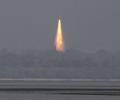
Enthused over its successful launch of GSLV D5 with GSAT-14 communication satellite from Satish Dhawan Space Centre in Sriharikota on Sunday, the Indian Space Research Organisation is planning a series of GSLV launches and an experimental launch of the advanced version GSLV Mark III soon from the spaceport.
'It is time we Indians learnt to believe in ourselves, and stopped questioning our own capabilities every time a space launch is not a glorious success,' says M D Riti.

The entire engine, Agnilet, is one piece of hardware from start to finish and has zero assembled parts, reports T E Narasimhan.

While Team Indus had backing from Nandan Nilekani, Ratan Tata and Flipkart founders Sachin and Binny Bansal, it could not even muster half of the Rs 4.5 billion it required for the mission to the moon.

The Indian space agency is all set to embark on its most complex mission.

Artificial Intelligence, innovation and next-generation technologies figured prominently during the high-stakes discussion between Prime Minister Narendra Modi and US President Donald Trump at the White House, as the two sides announced transformative measures, including the US-India TRUST initiative, roadmap on accelerating AI infrastructure and INDUS Innovation, to boost tech ties.
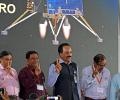
Ex-ISRO chairman G Madhavan Nair said the scientists at space agency have achieved this historic success by getting a salary one-fifth of the scientists in the developed world.

The FAC found that the failure happened when the Geosynchronous Satellite Launch Vehicle rocket's cryogenic engine was to kick in to take the rocket forward.
The decision was taken keeping in view aspects like servicing the operational launches of INSAT, potential commercial opportunities and strategic reasons.

The engine is earmarked for the LVM3-M3 mission identified for launching the next 36 OneWeb India-1 satellites, the Indian Space Research Organisation said.
'Every decision India makes along the LoC, it must also consider implications along the LAC.'
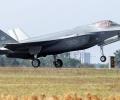
We need to equip the Indian Armed Forces, not 'commercial' as Trump wants, but 'operationally' looking at growing Chinese military capabilities, asserts Lieutenant General Prakash Katoch (retd).

Arianespace launch vehicle Ariane-5 VA-231, carrying GSAT-18 along with co-passenger Sky Muster II for the Australian operator nbn (National Broadband Network) was scheduled for launch at 2am on Wednesday.
The launch of the first-ever direct train service from Delhi to Kashmir would be a big turning point in the Valley's mood and its integration with India. He had to thwart it at any cost, asserts Shekhar Gupta.

The Trans-Lagrangian Point 1 Insertion manoeuvre marks the beginning of the spacecraft's about 110-day trajectory to the destination around the L1 Lagrange point, a balanced gravitational location between the Earth and the Sun.

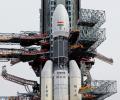
"I am extremely happy to announce that GSLV Mark III successfully injected Chandrayaan 2 in the defined orbit, infact the orbit is 6,000 km more than what was intended," Sivan said.

The soft landing of the spacecraft is planned for late August. The mission is expected to be supportive to future interplanetary missions.
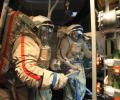
Finance Minister Nirmala Sitharaman on Wednesday allocated nearly Rs 12,544 crore to the department of space as India plans a human spaceflight -- Gaganyaan -- next year and sets out to explore the moon and neighbouring planets.
While industry is upbeat, start-ups in the space sector are finding it difficult to cater to the demand due to a lack of funding, issues related to policy like foreign funding, intellectual property, etc, and a lack of support in testing.

'We started AgniKul to show that space transportation should be as simple as road transportation.'

The successful launch of the maiden solar mission of the Indian Space Research Organisation came on the heels of the historic lunar landing mission - Chandrayaan-3.

The first Gaganyaan flight scheduled for 2022 will carry three astronauts, who will be picked from among the test pilots in the armed forces.

The Lagrange point 1 (L1) of the Sun-Earth system is about 1.5 million km from the Earth. It is about one per cent of the total distance between the Earth and the Sun.

A US court has asked Antrix Corporation, the commercial arm of Indian Space Research Organisation, to pay a compensation of USD 1.2 billion to a Bengaluru-based startup, Devas Multimedia, for cancelling a satellite deal in 2005.

The picture of Moon was taken by Chandrayaan-2's LI4 Camera from an altitude of about 2,650 km from the lunar surface.
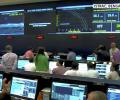
ISRO has said once the Lunar night falls, there would be no sunlight for the lander to generate power for its working and also it was not designed to operate in the heavy cold temperature of Moon during the phase.
India's premier defence research organisation DRDO has awarded seven new projects to private entities to develop key military assets including underwater launched unmanned aerial vehicle and long-range remotely operated systems.

The Indian Space Research Organisation successfully put India's heavy rocket Geosynchronous Satellite Launch Vehicle-Development 5 (GSLV-D5) into orbit from the spaceport at Sriharikota, Andhra Pradesh at 4.18 pm on Sunday.

Out of its 47 operational satellites, India currently has six to eight satellites which are used entirely for military purposes.

The announcement comes two days ahead of the proposed historic launch of the ISRO's 100th satellite along with 30 others in a single mission from Sriharikota.

Chandrayaan 3 follows the Chandrayaan 2 mission which did not achieve the desired soft landing on the surface of the moon in 2019, disappointing the scientists.
